
Photographing our Hidden Subterranean Worlds. The History and Heritage of Liverpool. Architecture, Landscapes and anything else that catches my eye…
Photography | Railway Career | Volunteering
Photography
I have enjoyed photography as an amateur for many years, still having most of my early photographic equipment safely stored away. As a teenager, my first proper camera was a Ricoh ‘KR5’ (1978). I later upgraded to the more advanced Ricoh ‘XR7’ (1982) as my interest grew. However, Nikon would become my main 35mm camera system of choice, after purchasing a Nikon ‘FA’ (1983). I quite soon after, bought a second Nikon ‘FA’ body along with a range of accompanying Nikon Nikkor lenses and accessories. I have been a Nikon SLR user ever since.
In addition to my two Nikon FA, 35mm cameras, I bought a ‘Mamiya C330f’ (1972) a Twin Lens Reflex (TLR), medium format camera. However, following the theft of the Mamiya, I purchased a ‘Zenza Bronica SQ-A’ (1982) a Single Lens Reflex (SLR) medium format system, which gained the nick name, ‘The Big Fella’. I still have my Bronica, lenses and accessories today, waiting eagerly to be used once again.
I was reluctant to make the change to digital cameras initially, given that the quality of film was far superior to what digital could manage in those early years. However there is no denying that digital has now caught up, maybe even surpassing film in terms of image quality. Though film can still very much hold its own in terms of quality, even today.
My digital SLR journey started with the Nikon D70, followed by a D200 and D300, as the quality of digital technology improved.
My camera’s of choice today, are the excellent Nikon D800 & D850 Full Frame (FX) digital SLR’s. They are excellent quality, solid and reliable workhorses, having both been used in quite harsh environments since new.
However, as convenient as the modern digital process has made photography these days, I do miss the good old days of film photography. To create your image, the photographing of your subject was just the start of the journey. The fun would continue in the dark room, processing your film, then of course printing the negatives. Watching as your image gradually appeared on the blank paper, immersed in the developer solution, a magical moment indeed. A fascinating process from start to finish, that is Sadly missing from today’s image making.
Infra-Red photography has always fascinated me, both in terms of the resulting images, but also because of the process involved in creating your image. Digital cameras have made Infra-Red photography much easier. This resulted in me having my old unused, ‘Nikon D200’ body converted to Infra-Red.
After leaving school, I studied Photography full time. One of the many assignments I was given during my studies, was to photograph the interior of a Chapel, within a convent in Mossley Hill, Liverpool. For this shoot, I used a 5×4 inch monorail camera which was a wonderful experience in itself, a real hands on all manual camera. I was surprised when the resulting image from this photo shoot, was chosen to be entered into the BIPP or ‘British Institute of Professional Photography’, competition by my course lecturer.
“The Chapel”, Convent in Mossley Hill, Liverpool.

To my amazement, “The Chapel”, went on to win ‘First Merit’ in the student category of the prestigious British Institute of Professional Photography competition (7th July 1985).
Other forms of photography that I enjoy are aerial photography and video, as well as the creation of 360° Virtual Reality Equirectangular Images. 360° images are made by taking a series of hi-Res images, covering the whole 360° scene. These images are then stitched together with specialist software to create the final 360° VR image.
Railway Career | Volunteering
Railway Career
My full time railway career began back in November 1985, lasting for over 38 years of railway service, when in January 2024, I had to take early retirement. I started with ‘British Rail’, firstly as a Drivers Assistant or Second Man, on freight services at Warrington Arpley. However, promotion meant that in early 1988, I became a trainee Train Driver, with MerseyRail at Birkenhead Central. However by Oct 1988 I had received notification that once my MP12, Driver training was complete, I was to return once again to Warrington Arpley, as a freight train driver.
Throughout the years on the railway…





An original typewritten letter, dated 28th October 1988, giving notification of my pending ‘8B’, Driver transfer from Birkenhead Central back to my original home depot, Warrington Arpley, on completion of my MP12 driver training course.
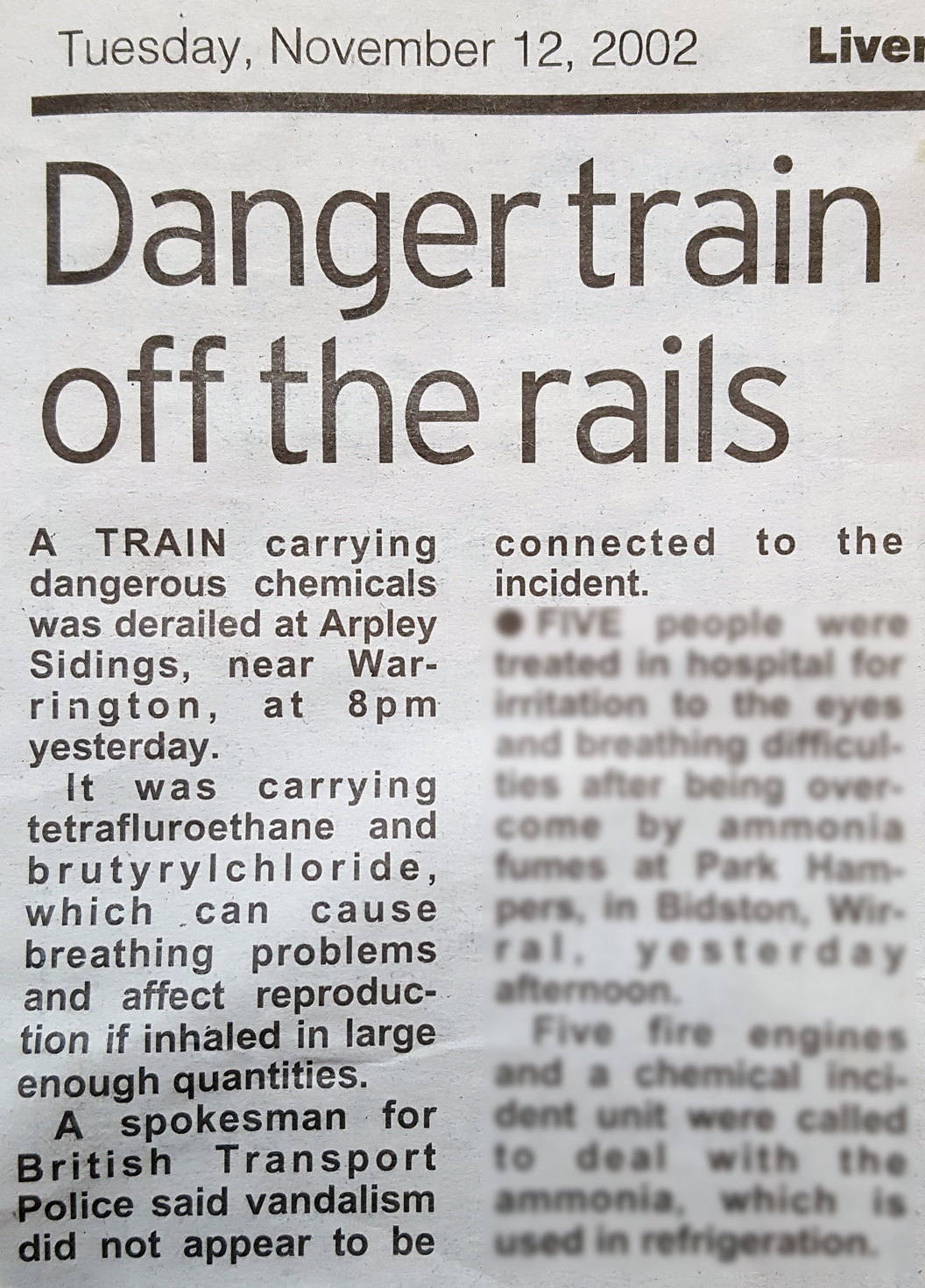
A Liverpool Echo news article, dated Tuesday 12th November 2002. Reporting on an incident involving a Freight liner train that I worked, from Ditton sidings to Warrington Arpley Sidings. My train was carrying dangerous goods, which became derailed under a bridge, entering Warrington Arpley sidings. The derailment was proven to be caused by a track defect.
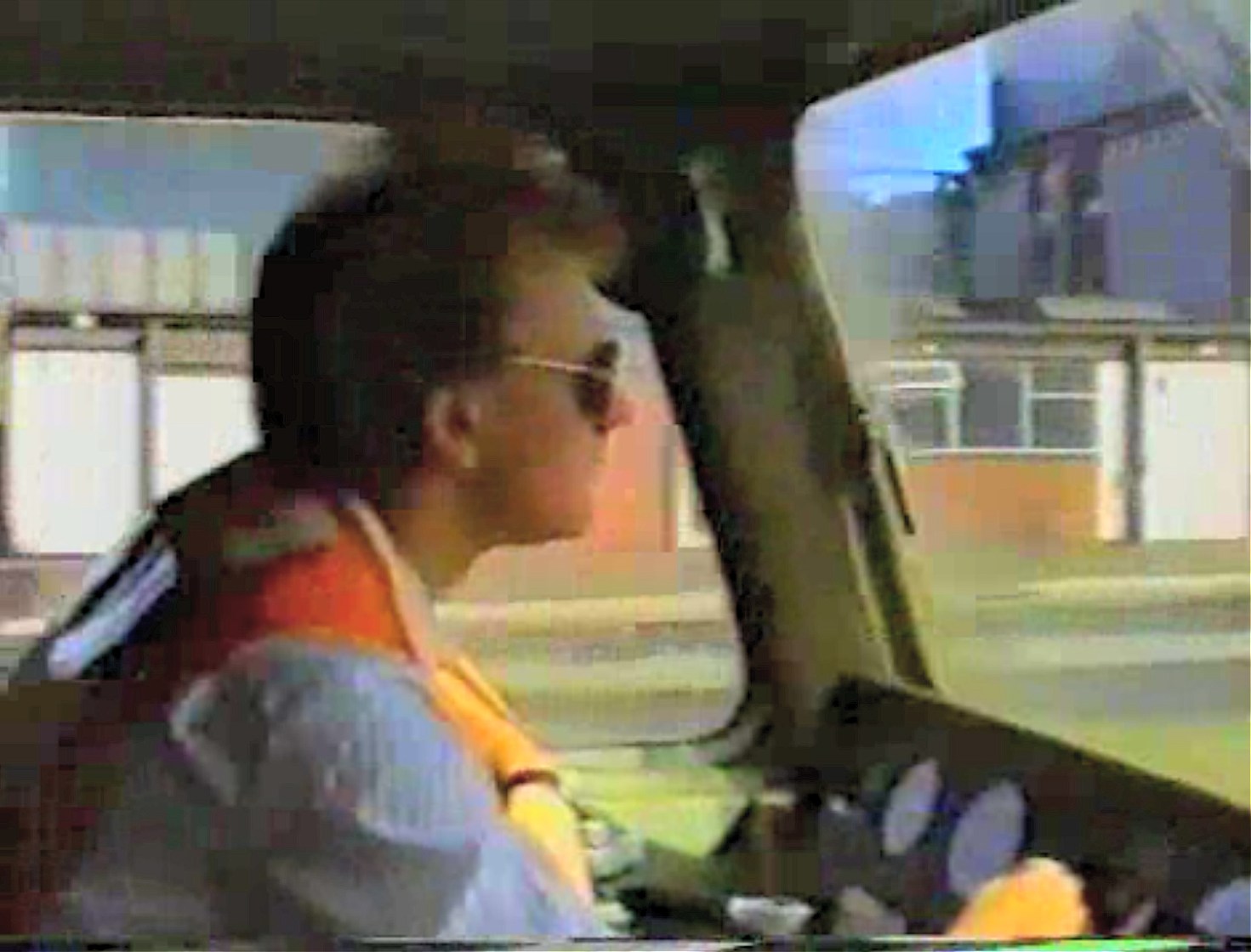
Three still images, all taken from video footage of me working 47500 from Warrington Arpley sidings to Castleton in 1992.
Another still image from a video of me working a train out of Union Salt, Folly Lane, in Runcorn with 31554 in 1998.
Here, I am about to work a Virgin Trains, London Euston to Liverpool Lime Street service, with 87008 “City of Liverpool” in 2003.
Whilst Hauling a Pendolino with a Class 57 Thunderbird loco to Holyhead, I was informed that there were sheep on the line between Llanfairfechan and Aber. I was attempting to lead the sheep off the line to safety, when the farmer appeared through the fence. Loco No and date not known.
At Ty Croes, on Anglesey, whilst working a Pendolino, dragged by 57305, “John Tracy”, Thunderbird Loco, to Holyhead. We were awaiting the arrival of assistance following the failure of our locomotive.
I am about to work Virgin Trains Pendolino, 390138 “City of London” on a snowy 2018 winter’s day from London Euston to Liverpool Lime Street.
These photographs were taken by friends and colleagues during my railway career. Therefore, they are not my Copyright. I acknowledge the copyright of the original photographer.
As the years passed, I progressed from working exclusively freight, to also driving ‘Travelling Post Office’ services, or TPO’s, where Post Office staff travelled onboard the train, sorting the mail during the journey to Wembley, London. I also worked many Special Passenger services, ranging from the famous “Northern Belle” to Heritage Charter services, Rail Tours and other Special Traction Excursions up and down the country. I worked trains from as far North as Ayr in Scotland, through Carlisle to the North West of England, North Wales (working coal trains from Point of Ayr Colliery, Penmaenmawr quarry Sidings & Holyhead). The Manchester area including Guide Bridge and Castleton. Then South to Wembley and Euston in London, via the West Coast Main Line, including the West Midlands, Birmingham and Stoke routes.
I have worked on many different classes of Locomotives over the years. Surprisingly, some of which are either on display in railway museums or operating in preservation at Heritage Railways. I think I must be getting old…
Classes of Locomotives and Traction Units, I have worked on during my 38 years on the railway.
Diesel Electric Locomotives
082, 202, 251, 312, 372, 40*1, 472, 562, 572, 593, 602, 662, 733
AC Electric Locomotives
Multiple Units
3902 Pendolino (125mph, Tilting Train – AC)
2212 Super Voyager (125mph, Tilting Train)
2202 Voyager (Non-Tilting Train)
5072 & 5082 (Mersey Rail Units – DC)
2533 (Class 43 Power car), 125 High Speed Train (HST)
107/108’s3 (BR slam door DMU, Blue Square)
Non Powered Vehicles
822 Driving Van Trailor (DVT)
NNA 94/952 Propelling Control Vehicle (Royal Mail, PCV)
Key
1 Locomotives I have driven as a second man or drivers assistant, under the guidance of a driver.
2 Locomotives I drove regularly as a driver, having been trained and passed out for that class of loco.
3 Locomotives I have driven as a driver when needed, under the guidance of a conductor driver.
* In 1985, some of the Class 40 locomotive fleet were reclassified as Class 97, for Departmental use only. They were used on the Crewe Station remodelling project as well as other engineering and ballast work until 1987. The Class 97 had a reduced maximum speed of 35mph due to their age and the condition of their bogies.
↑ back to Loco Classes
In 2003, I transferred once again from Warrington, where I had worked for BR ‘British Rail’ and EWS, ‘English Welsh & Scottish Railway’. Taking a position of driver at Liverpool Lime Street with ‘Virgin Trains, West Coast’. As a Virgin Trains Driver, I was delighted to have the opportunity to take part in the official launch of the brand new Virgin Trains Class 390, 125mph, Tilting Pendolino at London Euston, where I met Richard Branson at this special event.
Richard Branson at the launch event of the new Class 390, 125mph, Tilting Pendolino at London Euston Station.

During the following years, I would drive the Class 390, tilting ‘Pendolino’ daily, as well as the Class 221, tilting ‘Super Voyager’, on the West Coast Main Line from Liverpool Lime Street to London Euston and Holyhead.
Photography | Volunteering
Volunteering
The Friends of Williamson’s Tunnels – FoWT
I have been a Volunteer, Trustee, Guide & Photographer for the Registered Charity, the “Friends of Williamson’s Tunnels”, since December 1998. It has been a fascinating journey of discovery, exploring and digging in the tunnels, meeting many interesting people along the way. As a tour guide, taking many hundreds if not thousands of people on guided tours of Williamson’s Subterranean world. I have enjoyed photographing the tunnels, recording the progress of their discovery and restoration, in a photographic time line through the years.
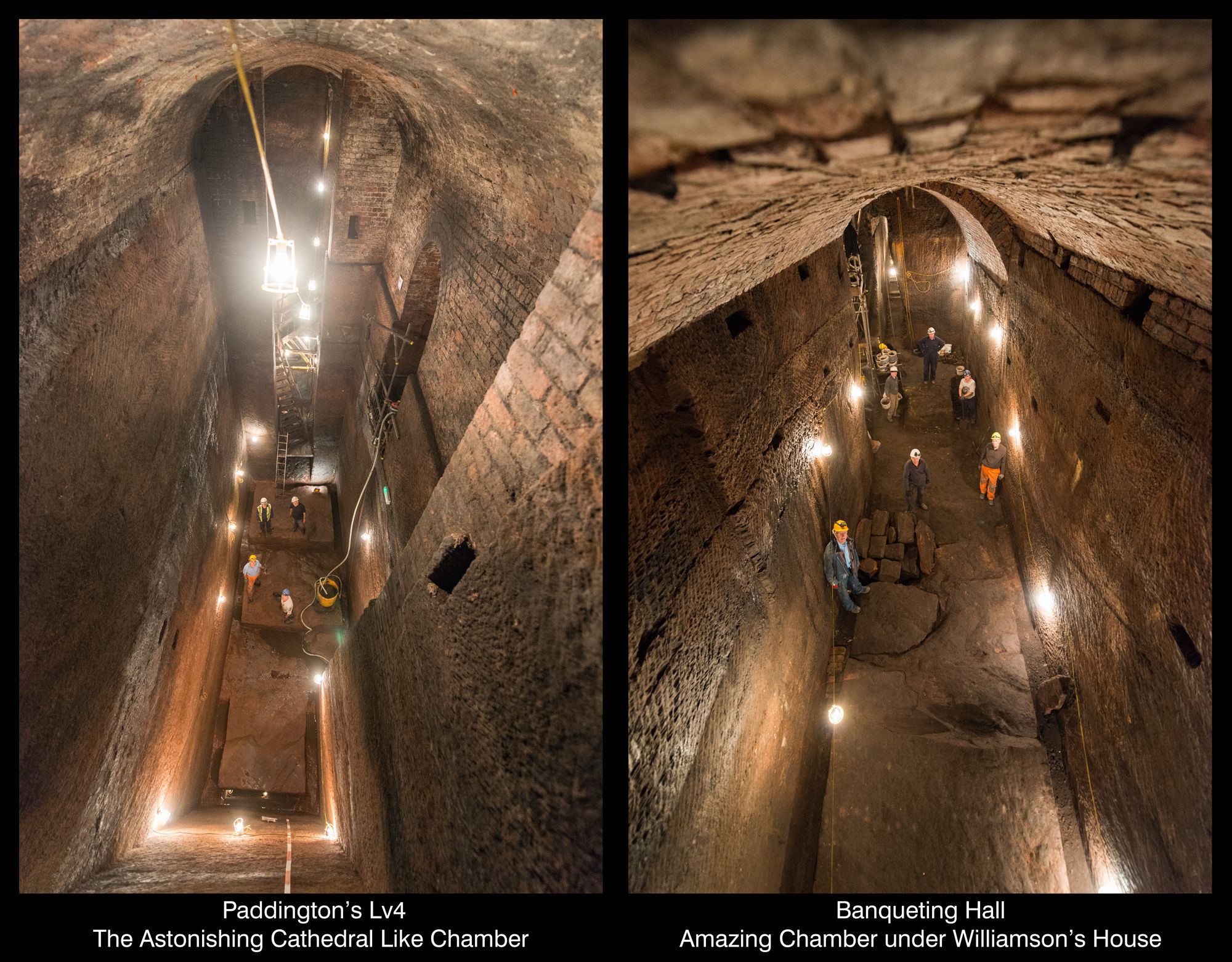
The grand, cathedral like chambers of the Williamson’s Tunnels.
Being involved in the Williamson’s Tunnels, also helped me achieve things I thought I could never do, things way outside my comfort zone. For instance, being a tour guide, assisting with talks and presentations and the planning and running of an international conference. The conference that I helped plan was the “5th International Symposium on Souterrains”, or for short, “Souterrains 2k2”, which FoWT hosted in 2002. However, the scariest thing I have ever done, was without doubt, being interviewed for Television and Radio on several occasions.
- BlueSky: Friends of Williamson’s Tunnels
- Web site: www.williamsontunnels.com
Liverpool & Manchester Railway Trust – LMRT
I am also a Trustee of the “Liverpool & Manchester Railway Trust”. We are determined to get Liverpool’s Railway Heritage recognised and appreciated by the world. Liverpool being the birthplace of Modern Railways.
LMRT we’re instrumental in getting ‘Scheduled Monument’ status of Edge Hill Engine Station, to give the recognition and protection that this important Liverpool and world Railway Heritage site deserves for the future.
The Wapping Cutting or Edge Hill Engine Station with (from left) the New Crown St Tunnel, The Wapping Tunnel and the 1829 Crown Street Tunnel.

Liverpool Land Rover Society – LLRS
I was a member and volunteer committee member of the ‘Liverpool Land Rover Society’ for several years. Helping to run the club, as well as being Webmaster for the society. LLRS was a club for like minded enthusiasts of the iconic Land Rover marque, who enjoyed to take their vehicles off road.

Photography | Railway Career
I’m proud of my home city of Liverpool, its History, Heritage and Architecture.
See how my images and video’s have been featured on TV, Radio and other media, over the years.
Most Popular Image Galleries
Most viewed Galleries, based on visitor statistics.
Random Image Galleries
Random Galleries, updated on each page refresh.
View T&C’s, Cookies, Privacy and Copyright statements.
Social Media



Home | Gallery | Top of Page
chrisiles.co.uk | © Chris Iles, 2015-2026
136,279 – Site Views
13,910 – Site Visitors
 Chris Iles - Photography | chrisiles.co.uk